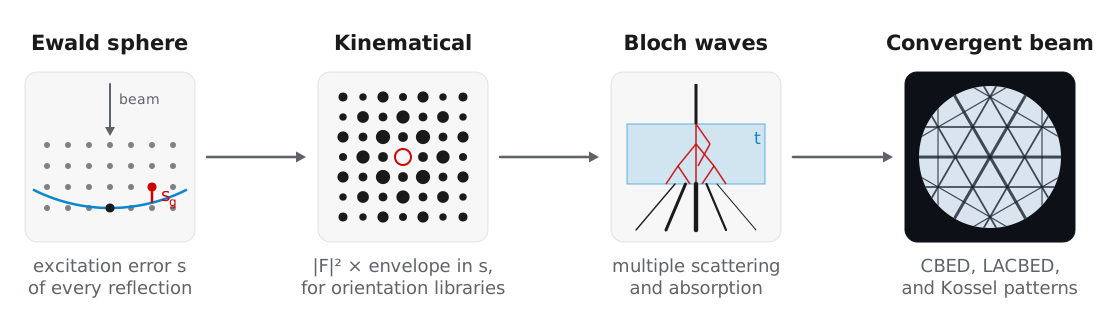
quantEM simulates electron diffraction from crystal structures with two models. Kinematical patterns are fast enough to build orientation libraries with thousands of zone axes. Bloch wave calculations include multiple scattering and absorption, and are needed when intensities depend on thickness, and for CBED, LACBED, and Kossel patterns.
An interactive version of these simulations runs in the browser, using the same structure factors as quantEM. Drag the crystal to tilt it, and adjust the thickness, convergence, and precession. The same simulator runs in Jupyter as quantem.widget.DiffractionSim.
Crystal structures
A Crystal is built from ASE or read from a CIF file with Crystal.from_cif. calculate_structure_factors computes the kinematical structure factors up to k_max from the scattering factors of Lobato and Van Dyck (2014):
from ase.build import bulk
from quantem.diffraction import Crystal

si = Crystal.from_ase(
    bulk("Si", "diamond", a=5.431, cubic=True),
    name="Si",
).calculate_structure_factors(k_max=3.0)
Kinematical patterns
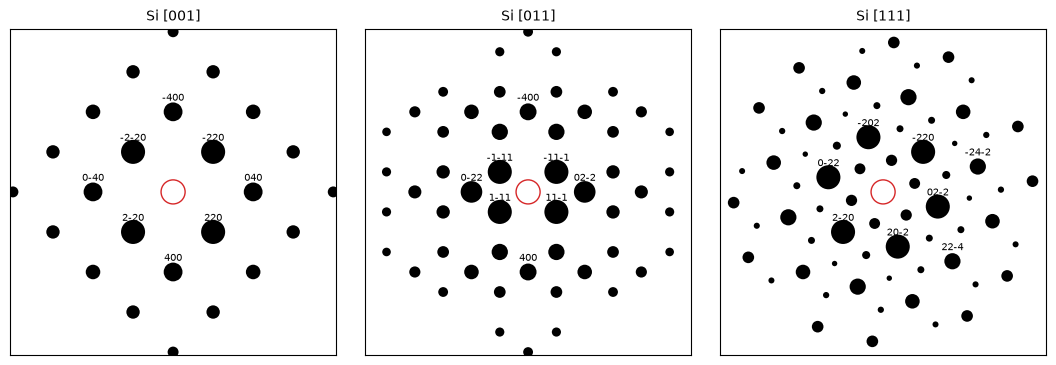
An orientation is a unit quaternion, and quat_from_zone_axis puts a lattice direction [uvw], or [UVTW] for hexagonal crystals, along the beam:
from quantem.diffraction.rotations import quat_from_zone_axis

q_011 = quat_from_zone_axis(si.direction_vector((0, 1, 1))[None])[0]
pattern = si.generate_pattern(q_011, energy_ev=200e3, k_max=1.5)
The intensity of each reflection is
where is the structure factor and is the excitation error, the distance from the reciprocal lattice point to the Ewald sphere. This is the model used for orientation matching.
Excitation error models
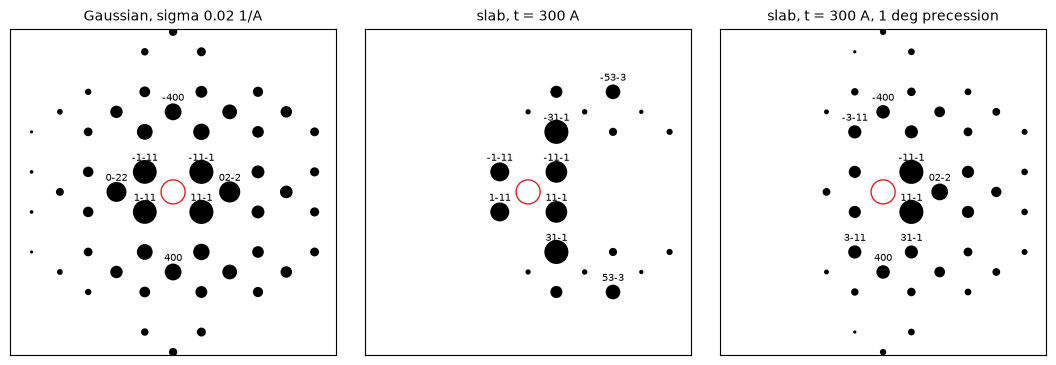
The Gaussian envelope above has a fixed width, sigma_excitation. The slab model, excitation_model="slab", instead uses the rocking curve of a foil of thickness , which is the thin crystal limit of the Bloch wave calculation. Either envelope can be averaged over a precession cone with precession_deg:
import numpy as np
import torch
from quantem.diffraction.rotations import qmult, quat_from_axis_angle

x_axis = torch.tensor([1.0, 0.0, 0.0], dtype=torch.float64)
q_tilt = qmult(quat_from_axis_angle(x_axis, torch.tensor(np.deg2rad(1.5))), q_011)

settings = {
    "Gaussian, sigma 0.02 1/A": dict(sigma_excitation=0.02),
    "slab, t = 300 A": dict(excitation_model="slab", thickness_A=300.0),
    "slab, t = 300 A, 1 deg precession": dict(
        excitation_model="slab", thickness_A=300.0, precession_deg=1.0
    ),
}
patterns = [
    si.generate_pattern(q_tilt, energy_ev=200e3, k_max=1.5, **kwargs)
    for kwargs in settings.values()
]
For silicon [011] tilted by 1.5°, the slab model excites only reflections near the Laue circle, and precession restores reflections on all sides:
Dynamical diffraction with Bloch waves
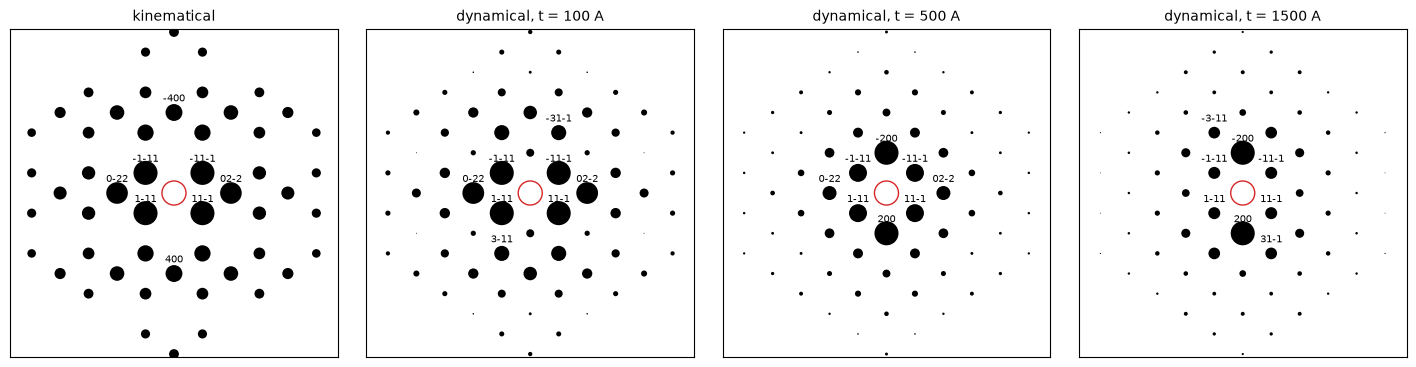
In thicker specimens, electrons scatter more than once and the intensities depart from kinematical values. quantEM computes dynamical intensities with the Bloch wave method of Bethe (1928), using the absorptive form factors of Weickenmeier and Kohl (1991). One eigendecomposition per orientation gives the intensities at every thickness:
from quantem.diffraction import bloch

si.calculate_dynamical_structure_factors(energy_ev=200e3, k_max=3.0)

thicknesses = np.arange(0.0, 2001.0, 10.0)
dyn = bloch.dynamical_pattern(si, q_011, thicknesses, energy_ev=200e3, k_max=1.5)
The (200) reflections of silicon are kinematically forbidden, but appear in the dynamical patterns by double diffraction:
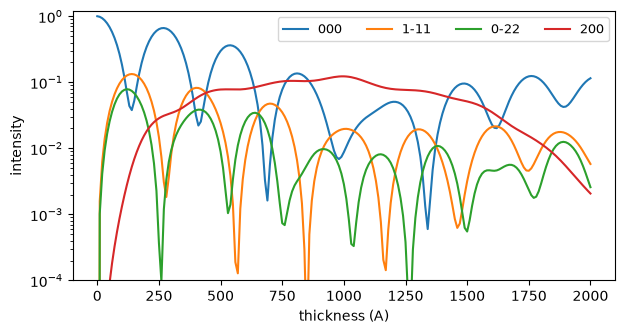
Each beam oscillates in intensity with thickness as it exchanges intensity with the others (Pendellösung), while absorption damps the oscillations:
CBED and LACBED
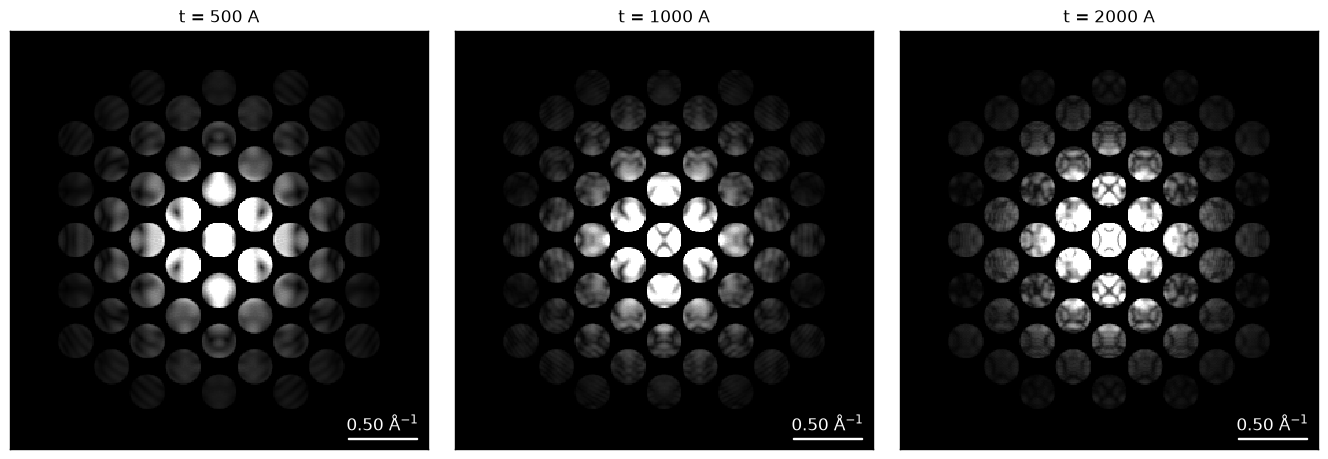
calculate_cbed treats each incident direction in the probe as an independent plane wave, which fills each disk with the rocking curve of its reflection:
cbed = bloch.calculate_cbed(
    si,
    q_011,
    [500.0, 1000.0, 2000.0],
    energy_ev=200e3,
    semiconv_mrad=3.0,
    n_rings=16,
    k_max=1.3,
)
calculate_lacbed maps the rocking curve of a single reflection over a larger aperture, without overlap from neighboring disks.
Kossel patterns
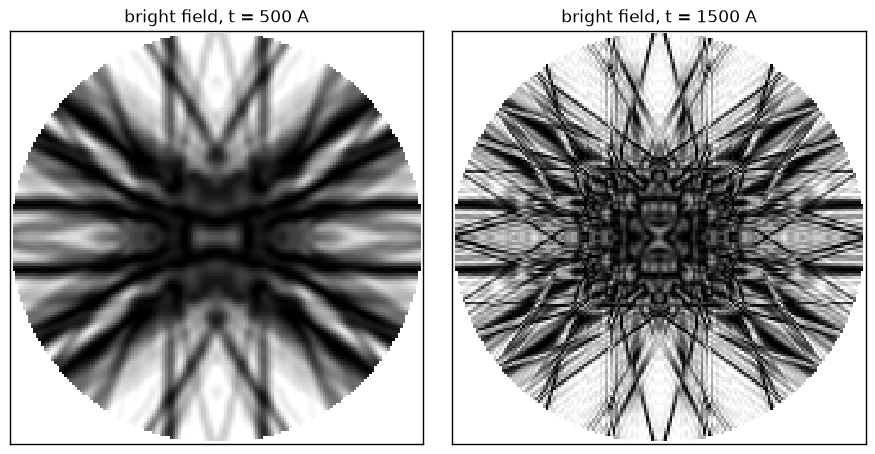
At convergence angles well beyond the Bragg angles, the disks overlap completely. Each reflection at its Bragg condition then removes intensity from the bright field, producing a dark line:
kossel = bloch.calculate_kossel(
    si,
    q_011,
    [500.0, 1500.0],
    energy_ev=200e3,
    semiconv_mrad=40.0,
    n_pixels=160,
    k_max=1.2,
)
The bright field depends only on the beam direction in the crystal, so one calculation over all directions covers every orientation, an approach used for EBSD master patterns by Callahan and De Graef (2013). calculate_kossel_reference stores this calculation, and kossel_from_reference extracts the pattern for any orientation in milliseconds:
reference = bloch.calculate_kossel_reference(
    si, 500.0, energy_ev=200e3, angle_step_mrad=2.0, k_max=1.2,
)
lines = bloch.kossel_lines(si, 500.0, energy_ev=200e3, k_max=1.2)
fig, ax = bloch.plot_kossel_reference(reference, si, lines=lines, max_index=3)

pattern = bloch.kossel_from_reference(
    reference, q_011, semiconv_mrad=40.0, n_pixels=160,
)["bright_field"]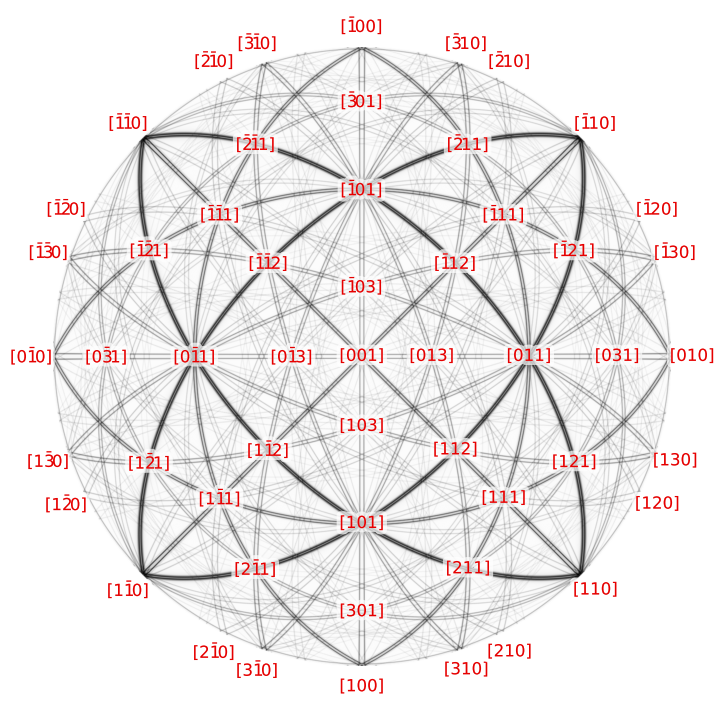
- Lobato, I., & Van Dyck, D. (2014). An accurate parameterization for scattering factors, electron densities and electrostatic potentials for neutral atoms that obey all physical constraints. Acta Crystallographica Section A Foundations and Advances, 70(6), 636–649. 10.1107/s205327331401643x
- Bethe, H. (1928). Theorie der Beugung von Elektronen an Kristallen. Annalen Der Physik, 392(17), 55–129. 10.1002/andp.19283921704
- Weickenmeier, A., & Kohl, H. (1991). Computation of absorptive form factors for high-energy electron diffraction. Acta Crystallographica Section A Foundations of Crystallography, 47(5), 590–597. 10.1107/s0108767391004804
- Callahan, P. G., & De Graef, M. (2013). Dynamical Electron Backscatter Diffraction Patterns. Part I: Pattern Simulations. Microscopy and Microanalysis, 19(5), 1255–1265. 10.1017/s1431927613001840